A Place Name Is a Clue, Not a Complete History
Learn how to read a place name without mistaking one element for a complete history; compare spellings, landscape and local records to assess each clue.
The common mistake with a place name is to treat one familiar element as a complete explanation: “-ford” must mean a river crossing, or “-ley” must describe a clearing. That shortcut can turn a useful clue into a false account of a county’s past. Read a place name by comparing its changing spellings with its setting and other local evidence.
Start with the name as it appears today
Imagine you are investigating a fictional county village called Mereford. Its name seems straightforward: “mere” might suggest a pool or lake, while “ford” may evoke a crossing. A nearby stream makes the second idea tempting, and a wet field appears to support the first. Neither observation establishes how the name began.
Write down the current form, then separate possible elements without assuming that modern spelling preserves an old meaning. Pronunciation, scribal habits and spelling conventions can all change a name. A familiar-looking syllable may once have sounded different or belonged to a longer word.
Keep competing readings open. One possibility is that Mereford refers to water and a crossing; another is that an older element was later reshaped into a familiar modern word. These possibilities are not automatically equally likely, but the first plausible reading is not settled just because it sounds neat.
Treat familiar elements as tentative clues
Place-name elements are not fixed labels. Their meanings depend on the language and period involved, the forms recorded over time and the elements with which they are combined. Even a well-known element may have more than one interpretation, so avoid assigning it a single definition without checking a specialist place-name source.
For instance, English place names ending in “-ton”, “-ham” or “-ley” may invite familiar readings connected with settlements, dwellings or clearings. Those are broad possibilities, not dependable translations of every name containing those letters. The element could have a different history, or the modern spelling could conceal a form that no longer resembles the apparent word.
Apply the same caution to landscape terms. “Green” does not by itself prove that a settlement grew around a communal green, and “Mere” cannot establish that a lake occupied the site. A name may refer to a feature that has vanished, shifted or lain outside the present settlement.
Compare recorded forms before choosing a reading
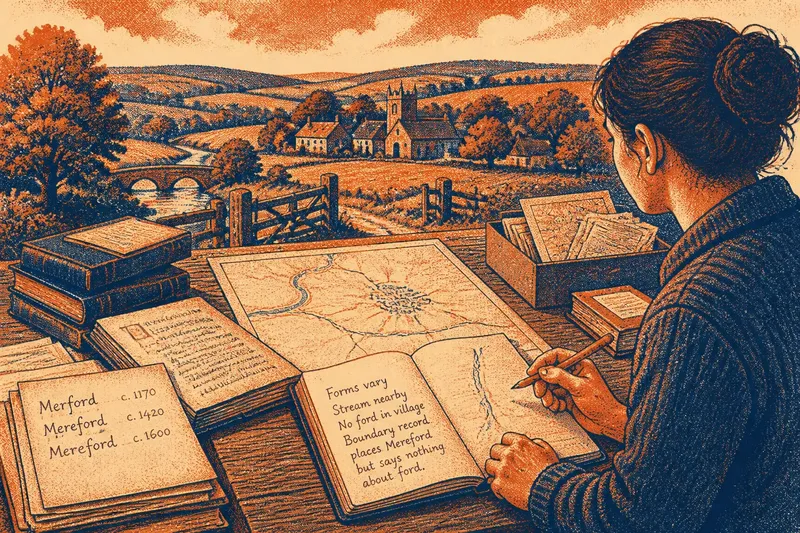
For Mereford, look for older recorded forms in county histories, parish material, estate papers and archive catalogues. Record each spelling with its date, source and surrounding context. If you consult a manuscript image, distinguish what you can read from an editor’s transcription.
Say an invented early record calls the village “Merford”, while a later local list gives “Mereford”. The difference raises a question: did spelling change, or does the earlier form preserve a different sound? It does not answer that question on its own; a single form may reflect a scribe’s habits rather than local speech.
Look for a pattern across records, rather than selecting whichever spelling supports your preferred account. Check that the entries refer to the same place, using neighbouring settlements, boundaries or landholdings as context. A repeated name can still be ambiguous if the document does not identify the locality clearly.
Check the landscape without forcing a match
Return to Mereford with your spelling notes. A historic map might show a stream but no obvious crossing at the settlement, while a local record might mention a crossing elsewhere nearby. That would weaken a confident claim about the village centre, but it would not rule out a wider place-name reference or an earlier route.
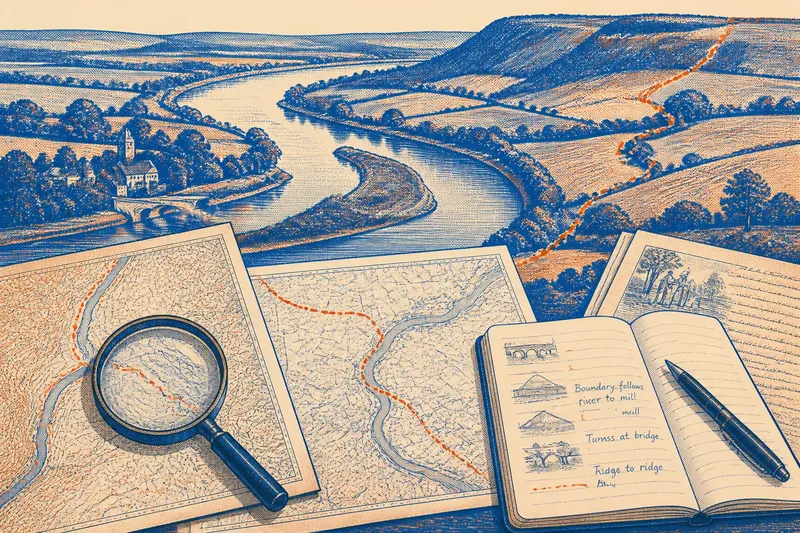
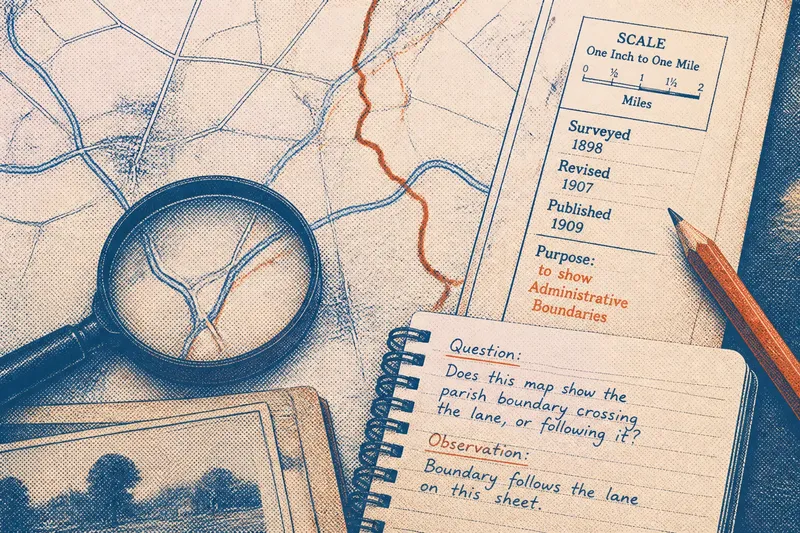
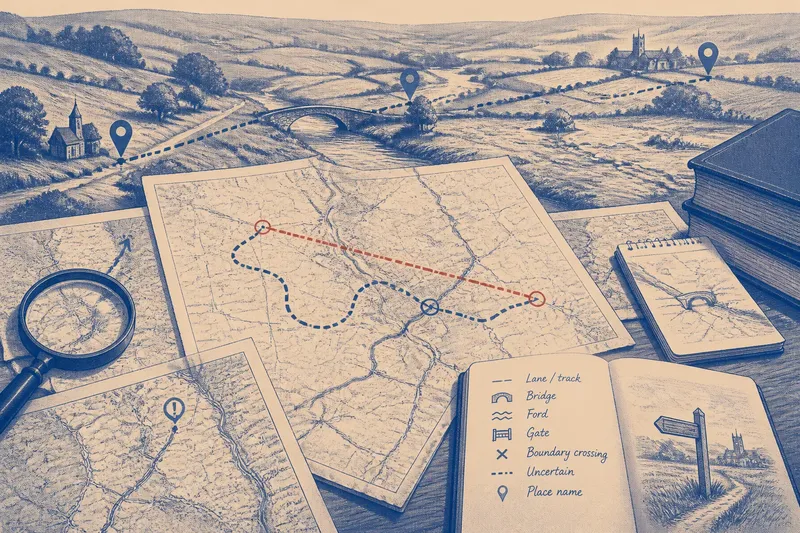
Use maps and landscape observations to ask focused questions. Look for old watercourses, changes in drainage, settlement patterns and field names that might offer related clues. A map is like a labelled box: it organises what was recorded, but its labels do not explain everything inside.
Compare the name with parish records, land descriptions and boundary documents. A record placing the settlement beside wet ground may support a water-related interpretation, but cannot establish the precise meaning of a word. If a source says nothing about a crossing, that silence is not proof that no crossing existed.
Imagine a researcher finds that Mereford’s oldest available forms vary and that a mapped stream runs near, but not through, the historic settlement. The researcher records the forms, checks the map’s context, then compares a boundary description that identifies the settlement but says nothing about a ford. The resulting note is that water-related elements remain possible, while the exact referent and any crossing site are unresolved; the boundary record helps locate the place but does not settle the name’s meaning.
Which questions help you read a place name?
Does an ending such as “-ford” prove there was a crossing?
No. It may suggest a crossing-related element, but the name alone does not identify a site or establish when it was used. Compare old forms with waterways, routes and local records before proposing a location.
Why do older spellings matter?
They can show how a name changed and may preserve sounds that the modern form obscures. Read them in context: a spelling in one document may reflect a clerk’s choices or refer to another place.
Can today’s landscape explain the original name?
It can offer a comparison, but the landscape may have changed since the name arose. Treat present-day features as evidence to compare, not as a direct picture of the past.
What should I do when the clues disagree?
Keep the disagreement visible and state which evidence points in each direction. When spellings, maps and records do not converge, qualify the interpretation rather than forcing an answer.
Separate the evidence from the interpretation
In your notes, distinguish the recorded form, the proposed elements and the historical claim built from them. You might write that a name “may contain” a particular element, then identify the spelling or local record that makes the proposal plausible. Do not turn a possibility into a fact simply because it produces a tidy explanation.
When a reading depends on difficult handwriting, an unfamiliar language form or local archival conventions, consult a specialist place-name reference or ask an informed local archivist. Keep the source details and uncertainties together so another reader can follow your reasoning.
A place name is most revealing when treated as one strand in a county’s evidence, not as a miniature history that explains itself. For Mereford, the useful result is a clear account of the forms, alternatives and limits—not a firm tale of a lake and a ford. When you search for place-name clues, let the records support the interpretation rather than asking a familiar ending to settle it.